High-resolution seismic imaging, least-squares migration, wave-equation tomography, full waveform inversion, extended waveform inversion, GPU-accelerated seismic imaging/inversion, etc.
High-resolution Stacking of Seismic Data with Fast Capon Beamforming:基于快速Capon波束形成的高分辨率地震数据叠加

We introduce a Capon beamforming-based stacking method, adapted from medical imaging, to enhance the vertical resolution of seismic images by suppressing misaligned signals and noise. Unlike conventional stacking, our approach applies adaptive data-dependent weights as spatial filters, reducing frequency loss and improving resolution. To overcome computational challenges, we propose an efficient implementation that eliminates matrix inversion, significantly improving efficiency. Numerical tests demonstrate the method’s effectiveness in resolving high-frequency signals, reducing artifacts, and enhancing the interpretability of subtle geological features.
Y. Liu, Y. Luo, Y. Ma, H. Liu, High-resolution Stacking of Seismic Data with Fast Capon Beamforming, IEEE Geoscience and Remote Sensing Letters, 2024, 21, 1-5.[pdf]
Accelerated Kirchhoff depth migration on CPU-GPU heterogeneous computing systems:基于CPU-GPU异构计算系统的快速Kirchhoff深度偏移
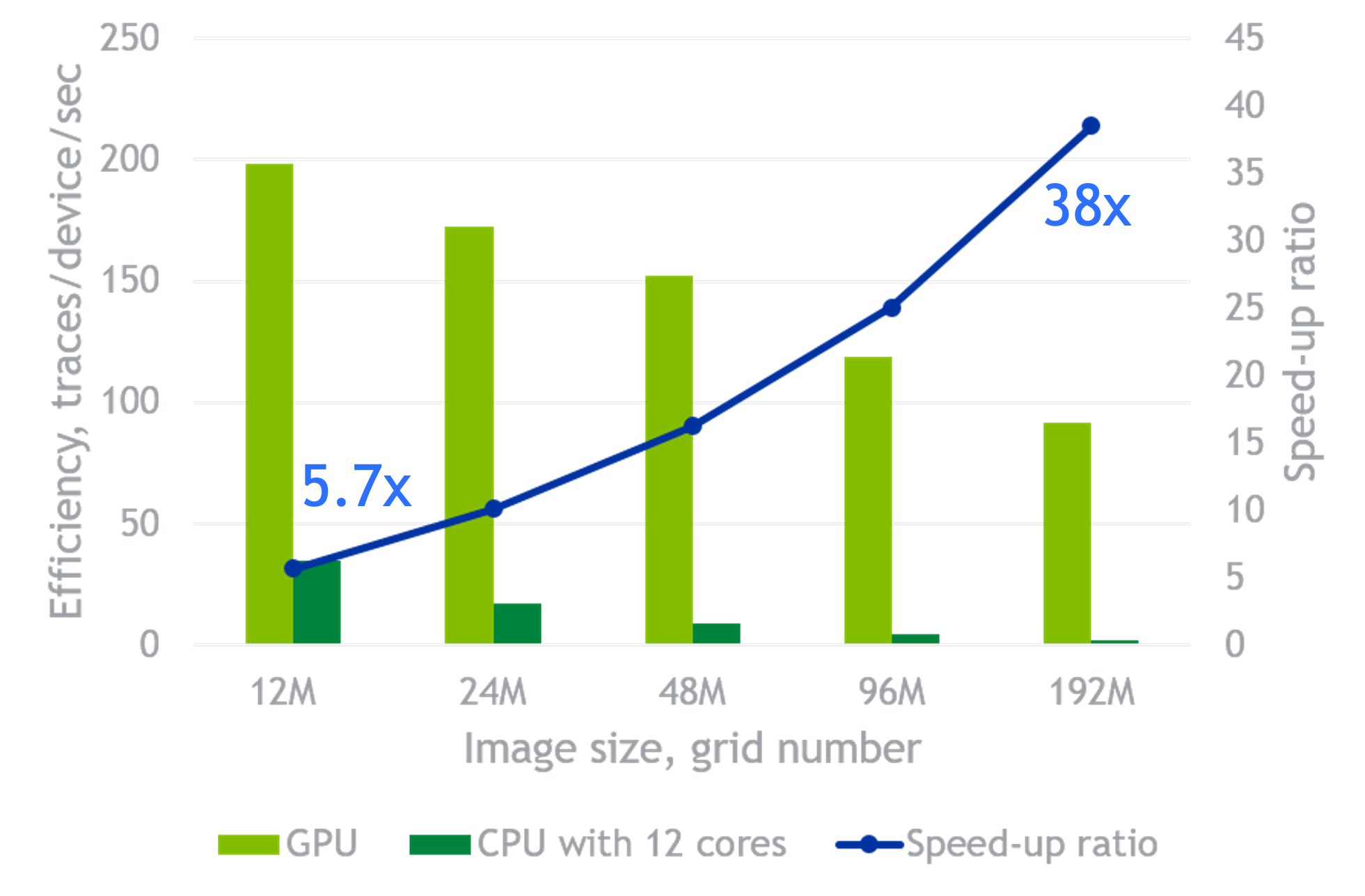
Kirchhoff Depth Migration (KDMIG) is a widely used seismic technique for imaging complex geological structures, but the increasing volume of 3D seismic data has significantly raised its computational cost. To address this, an accelerated KDMIG algorithm has been developed using a CPU-GPU heterogeneous parallel computing system. Four strategies—cross-spread sorting, texture interpolation, multi-stream computation, and parallel architecture optimization—have been implemented to maximize the supercomputer’s performance. Numerical tests show that the new algorithm achieves up to a 40x improvement in efficiency compared to the CPU-only version, without compromising imaging accuracy.
Y. Liu, H. Liu, Y. He, F. Qin, and Y. Du, Accelerated Kirchhoff depth migration on CPU-GPU heterogeneous computing systems, 2nd International Meeting for Applied Geoscience & Energy, 2022. [pdf]
 Yujin Liu