High-speed train induced seismic, drill-bit generated seismic, fracking stimulated seismic, ambient noise seismic, etc.
The seismic broad-band signature of high-speed trains running on viaducts:高架桥上运行的高铁产生宽频地震信号
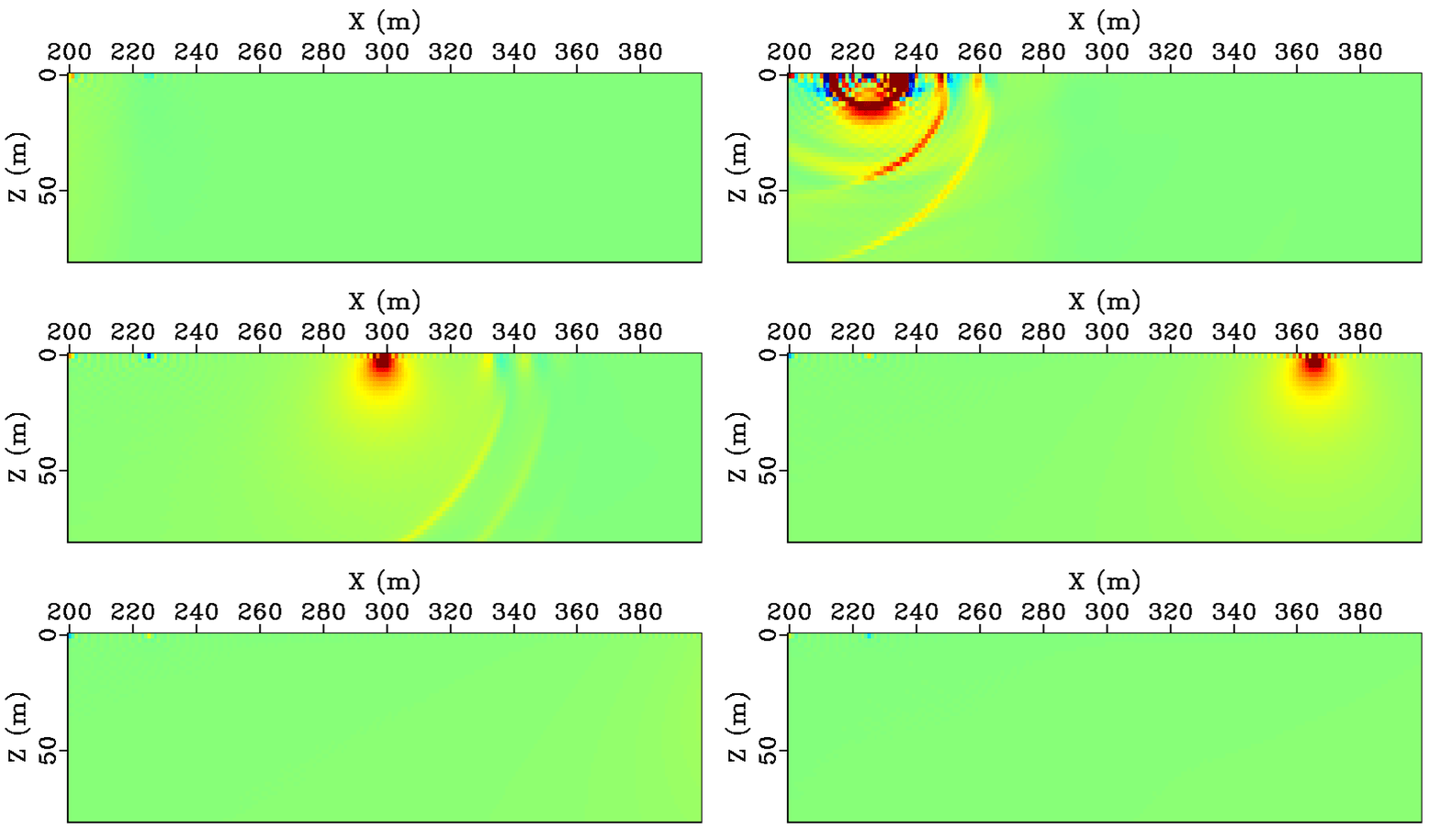
High-speed trains (HST) generate significant ground vibrations during operation, yet the far-field propagation of these vibrations has been insufficiently explored. This study derives two analytical formulas for the seismic wavefields induced by HSTs under the far-field approximation, analyzing scenarios where the train runs on either a ground track or a viaduct. The results show that vibrations from HSTs running on the ground decay exponentially, while those from trains on viaducts produce broad-band seismic waves that penetrate deeper into the Earth. The formulas are validated with field observations, and numerical results indicate that HST-induced vibrations from viaducts can serve as a cost-effective, repeatable source for imaging and monitoring subsurface structures.
Y. Liu, Y. Yue, Y. Luo, and Y. Li, The seismic broad-band signature of high-speed trains running on viaducts, Geophysical Journal International, 2021, 226(2), 884-892. [pdf]
Effects of high-speed train traffic characteristics on seismic interferometry:高铁振动信号特征对地震干涉成像的影响
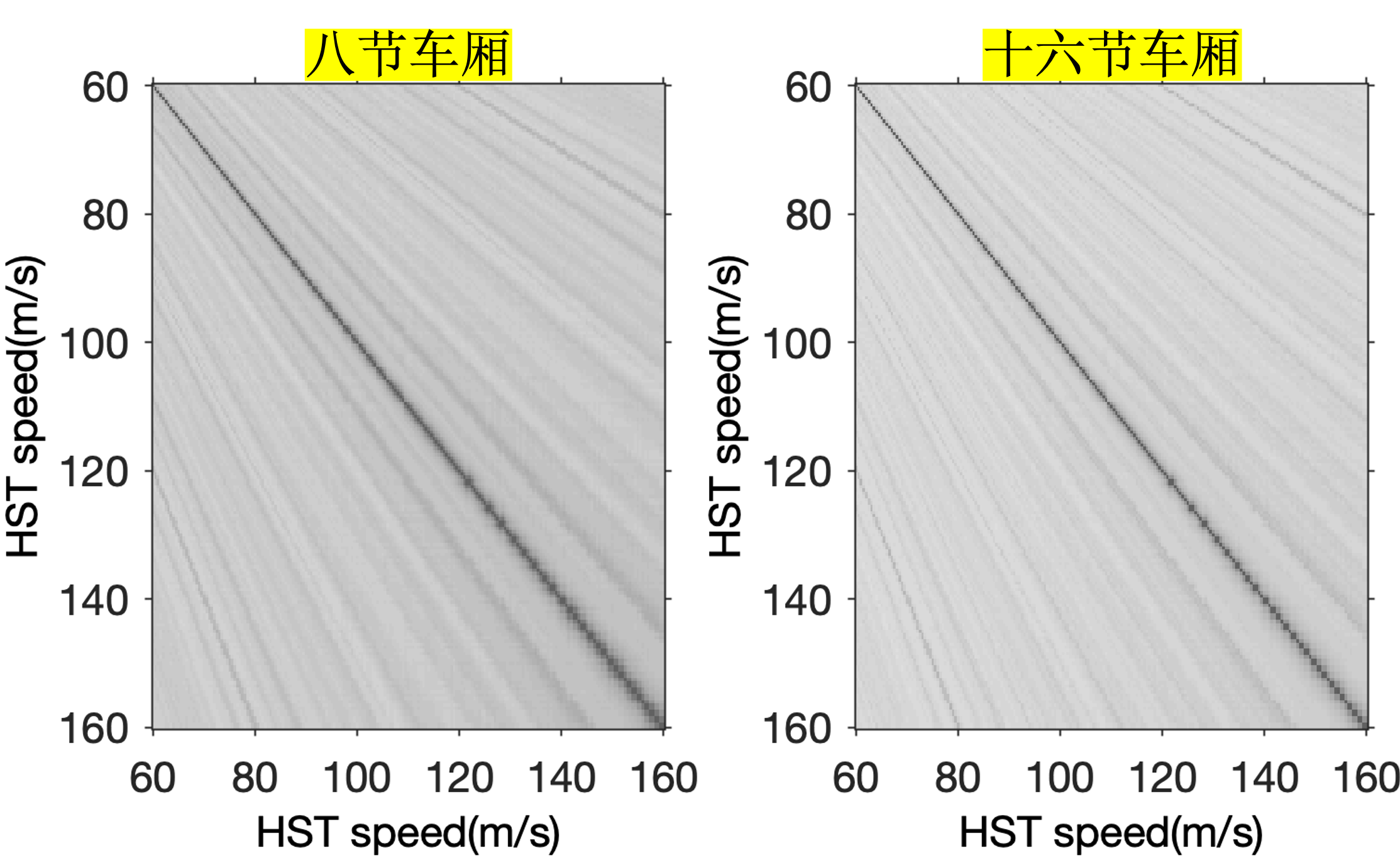
Train traffic, especially from high-speed trains (HSTs), is a valuable noise source for subsurface imaging due to its strength, cost-effectiveness, and repeatability. HSTs produce vibrations with sharp equidistant spectral lines, which can be used for seismic interferometry, similar to traditional train-induced vibrations. This study explores the effects of HST traffic on seismic interferometry by presenting a derivation that does not assume uncorrelated sources. We analyze factors such as HST direction, carriage number, rail structure, speed, and stacking of records. Results show that crosstalk in interferometric data can be reduced by stacking records from HSTs with slightly different speeds. This approach, validated with synthetic and field data, allows for the retrieval of surface waves that can be used to estimate near-surface velocities.
Y. Liu, Y. Yue, Y. Luo, and Y. Li, Effects of high-speed train traffic characteristics on seismic interferometry, Geophysical Journal International, 2021, 227(1), 16-32. [pdf]
On the Retrievability of Seismic Waves From High-Speed-Train-Induced Vibrations Using Seismic Interferometry:利用地震干涉法从高铁振动中提取地震波的可获取性
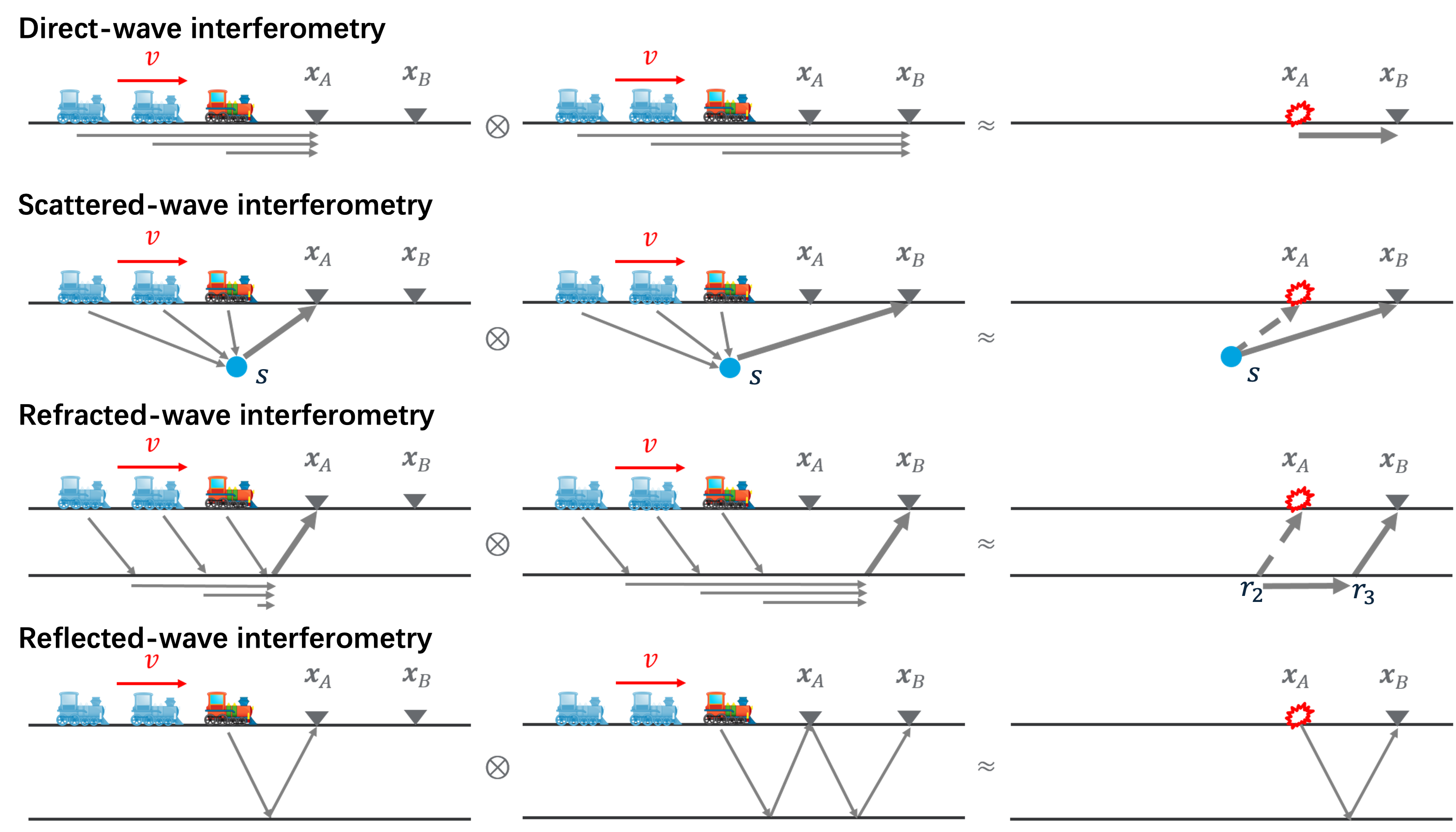
High-speed trains (HST) generate strong, repeatable vibrations that can be utilized for subsurface imaging and monitoring. Unlike other ambient noise, HST vibrations come from a moving, deterministic source. This study investigates the seismic waves retrievable from HST-induced vibrations using seismic interferometry. The analysis reveals that cross terms introduced during cross-correlation affect reflection-wave retrieval but can be ignored for direct, scattered, and refraction waves. Field data tests validate this finding. Additionally, the retrieved surface waves are shown to estimate near-surface velocities, while scattered surface waves can help locate near-surface heterogeneous structures.
Y. Liu, Y. Yue, Y. Li, and Y. Luo, On the retrievability of seismic waves from high-speed-train traffic using seismic interferometry, IEEE Geoscience and Remote Sensing Letters, 2022, 19, 1-5. [pdf]
Source location with cross-coherence migration:互相干偏移法震源定位
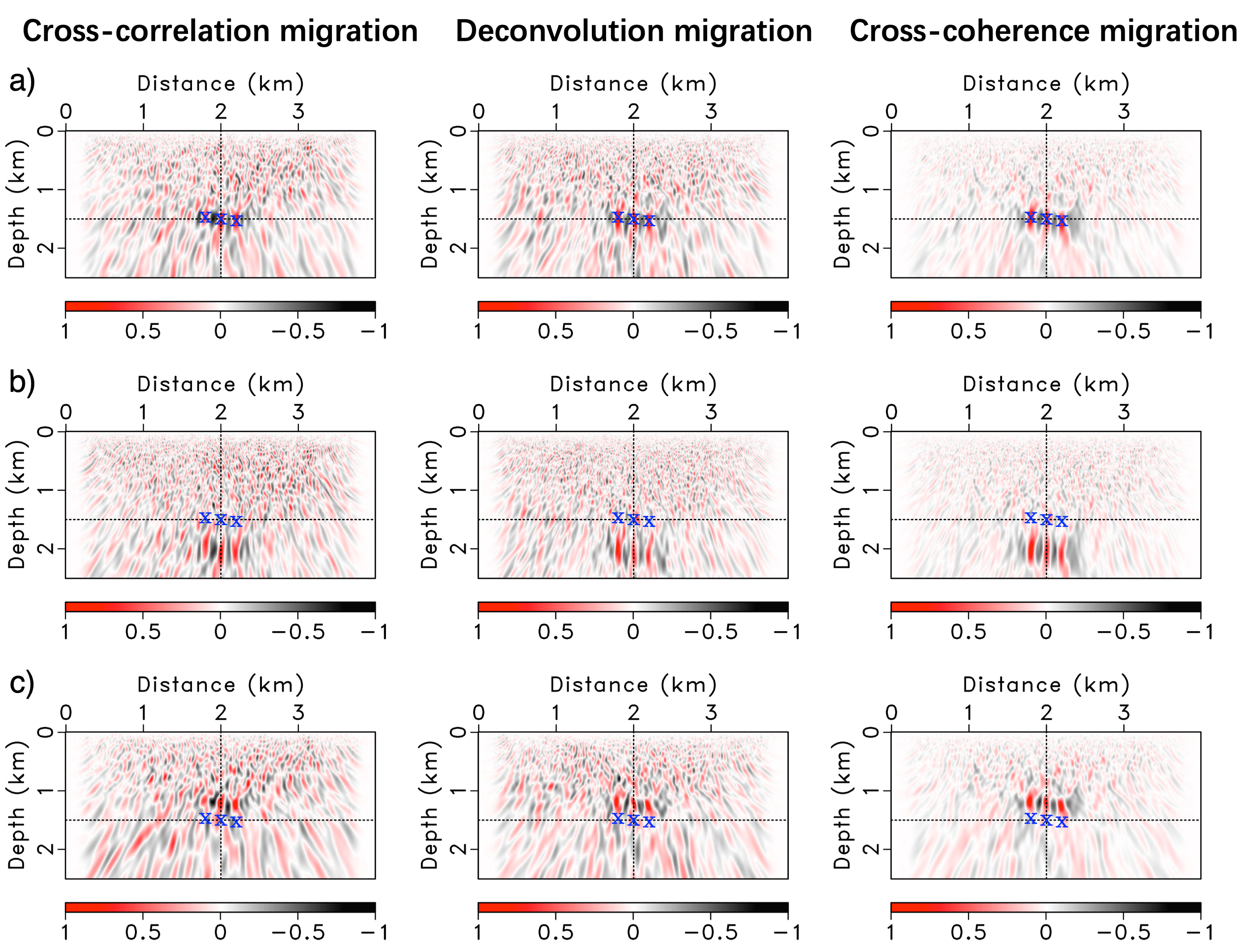
Determining microseismic source positions from hydraulic fracturing emissions is crucial for optimizing fracking parameters and enhancing hydrocarbon extraction. Interferometric cross-correlation migration (ICCM) and zero-lag autocorrelation of time-reversal imaging (ATRI) are two key methods for passive seismic source localization, previously considered distinct. This study proves their theoretical equivalence and introduces cross-coherence, which normalizes spectral amplitudes to improve both methods. Cross-coherence enhances spatial resolution and performs effectively under strong noise. Synthetic and field data tests confirm the equivalence of ICCM and ATRI, as well as their improved versions, demonstrating superior resolution and noise resistance compared to conventional approaches.
Y. Liu, Y. Ma, and Y. Luo, Source location with cross-coherence migration, GEOPHYSICS, 2020, 85(4), KS127-KS138. [pdf]
Locating passive sources on seismic reflection image in the presence of velocity errors:速度错误时将被动源正确定位于地震构造图像的相对位置
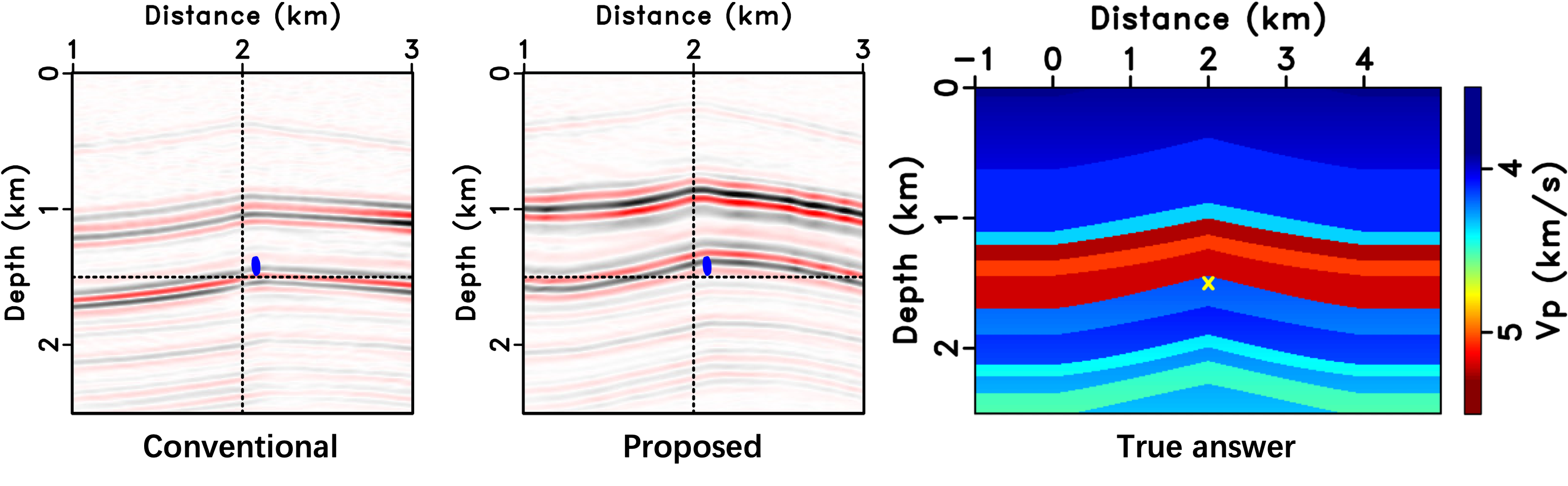
Locating microseismic events is crucial for monitoring hydraulic fractures, with time-reversal imaging (TRI) being a prominent method. TRI focuses on reconstructed receiver wavefields to pinpoint source positions but is highly sensitive to velocity model errors, which are difficult to refine in complex subsurface structures. To address this, we propose a method that locates microseismic events on seismic reflection images without requiring an accurate velocity model. While it does not place events at precise depths, it aligns them with seismic reflections, providing accurate local structural information. Theoretical analysis reveals that velocity inaccuracies shift imaged depths, with faster velocities yielding shallower source locations and slower velocities producing deeper locations, analogous to focusing depth behavior. Therefore, we propose to match the locations of microseismic events with the well-focused seismic reflection image, which is extracted by slicing the time-shift common image gathers at the time lag where the image has the maximal energy.
Y. Liu, Y. Ma, S. Han, and Y. Luo, Locating passive sources on seismic reflection image in the presence of velocity errors, GEOPHYSICS, 2020, 85(5), KS161-KS170. [pdf]
Sparsity-promoting least-squares interferometric migration for high-resolution passive source location:稀疏约束最小二乘干涉偏移进行高分辨率被动源定位
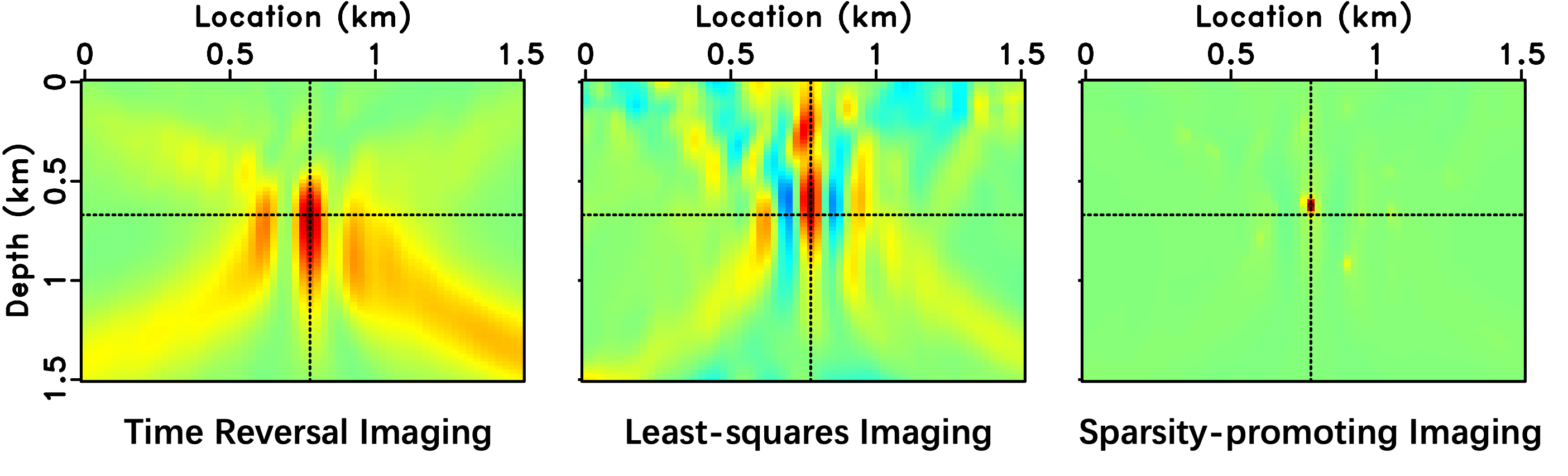
Seismic source localization is critical for estimating earthquake hypocenters and monitoring hydraulic fracturing. Interferometric cross-correlation migration (ICCM) is a key method for creating source images from interstation cross-correlations without manual picking. However, ICCM suffers from image blurring in scenarios with limited acquisition apertures, sparse receivers, or low signal-to-noise ratios, making it challenging to resolve closely spaced sources—a necessity for tracking fracture evolution. While least-squares ICCM (LS-ICCM) improves resolution by fitting a source power-spectral density (PSD) to observed correlations, its enhancement is limited. To address this, we propose a sparsity-promoting ICCM (SP-ICCM) method, imposing a sparsity constraint on the source PSD to counteract resolution loss from incomplete information. Using an iteratively re-weighted least-squares algorithm, SP-ICCM effectively mitigates the effects of unfocused sources. Synthetic and field data tests demonstrate the method’s robustness to noise and its ability to resolve closely spaced sources in complex geological settings.
Y. Liu, Y. Du, and Y. Luo, Sparsity-promoting least-squares interferometric migration for high-resolution passive source location, GEOPHYSICS, 2021, 86(1), KS1-KS9. [pdf]
 Yujin Liu